
.JPG)
Products that reach users safe, intuitive, and cleared don't happen by accident. Engenious builds usability into device design from the first concept and tests it before launch, running HFE end to end from early formative research through summative validation.
Finding use errors early keeps programs on schedule and avoids usability-related launch failures. Engenious gets into the field before design directions are set, observing clinicians and patients where care actually happens, from homecare to critical care to the operating room. We turn what we see into practical use specifications, a use-related risk analysis (URRA), and the design inputs that drive engineering forward.
Engenious plans and executes summative usability testing that gives clients the human factors engineering report their FDA submissions need. We define and evaluate critical tasks, analyze use errors and residual risk, and align every step with FDA human factors guidance in compliance with IEC 62366-1. Our team has supported usability work across infusion systems, electrosurgery, surgical systems, home care devices, and more.
.JPG)
Engenious recruits the right study participants faster through our Clinical Insights panel of practicing healthcare professionals. Most firms start from scratch for every study, burning time most projects don't have. Our panel supports both formative sessions and summative validation, so studies start sooner and stay grounded in the clinical reality of the product.
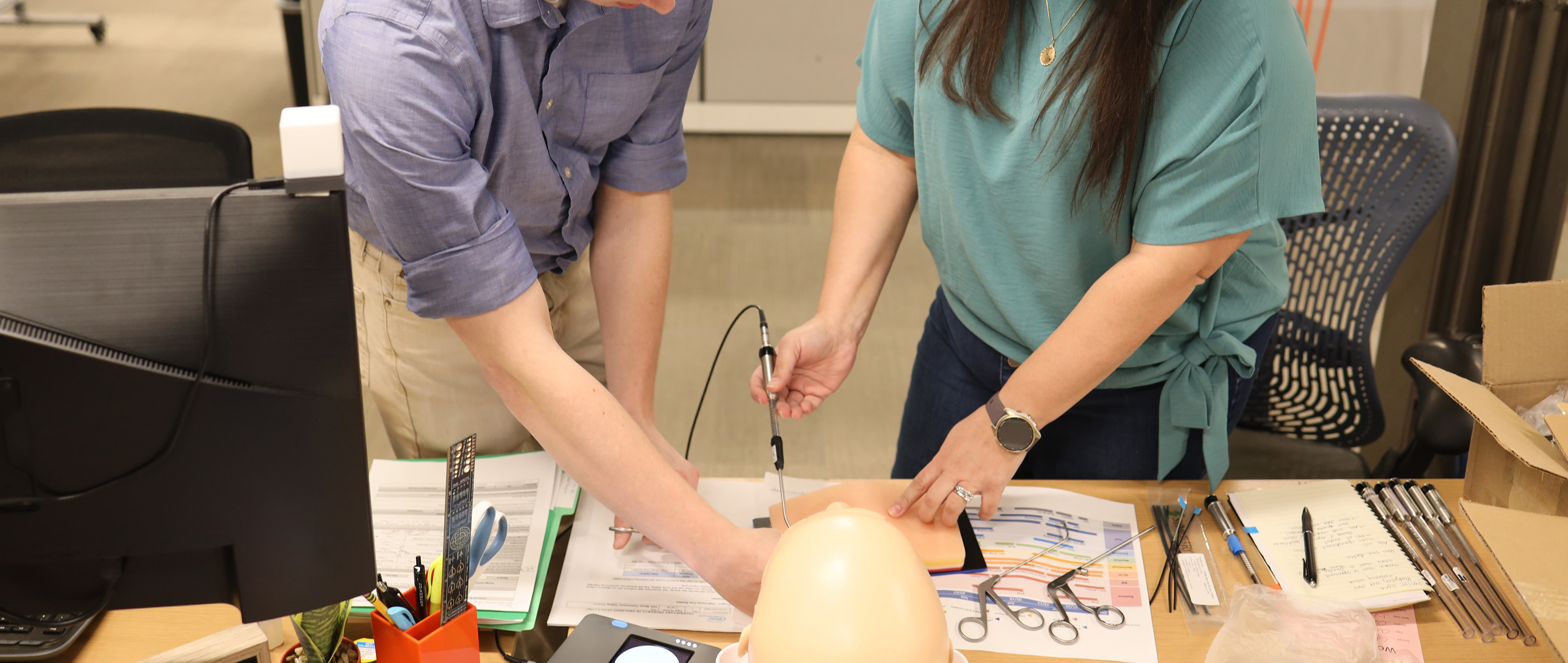
Specialist labs hand you a report. Engenious brings this insight directly to the engineers and designers in the offices next door. Because human factors, industrial design, user interface design and engineering work under one roof, what we learn from users becomes design changes in days, with no vendor handoff in between. Our ability to quickly prototype physical UI's accelerates the feedback loop even more.
Engenious was asked to develop the next generation of the NTrainer, a device that helps remediate non-nutritive sucking in newborns. The existing platform passed summative testing on the first full study, shipped to production, and was ultimately acquired by a top 100 medical device company.
The original platform had several usability problems. It was physically large and hard to maneuver in the NICU. The interface was highly clinical and non-intuitive. The UI was not designed for premature babies, who are easily overstimulated and stressed.
Formative research began with a deep dive into the MAUDE database, the customer complaint files, and a technical breakdown of the existing product. We then ran in-context formative studies of the current device with clinicians, which produced a detailed task analysis. Three findings drove our design inputs. First, the UI needed to support easier note-taking with less keyboard entry. Second, it needed to adapt to the low-light conditions of a NICU with sleeping babies. Third, the form factor needed to reduce cord entanglement risks, and the overall footprint needed to shrink substantially.
Our human factors team worked alongside the project engineers and designers to translate formative data into accurate user needs, product requirements, and risk analysis throughout the design process.
.JPG)
The overall system passed summative studies after one dry run and one full study with clinicians at a simulation hospital.
The user interface design passed summative testing with no revisions on the first pass, which shortened the development cycle significantly.
The NTrainer was adopted into production and ultimately acquired by a top 100 medical device company.
.JPG)
.jpg)

