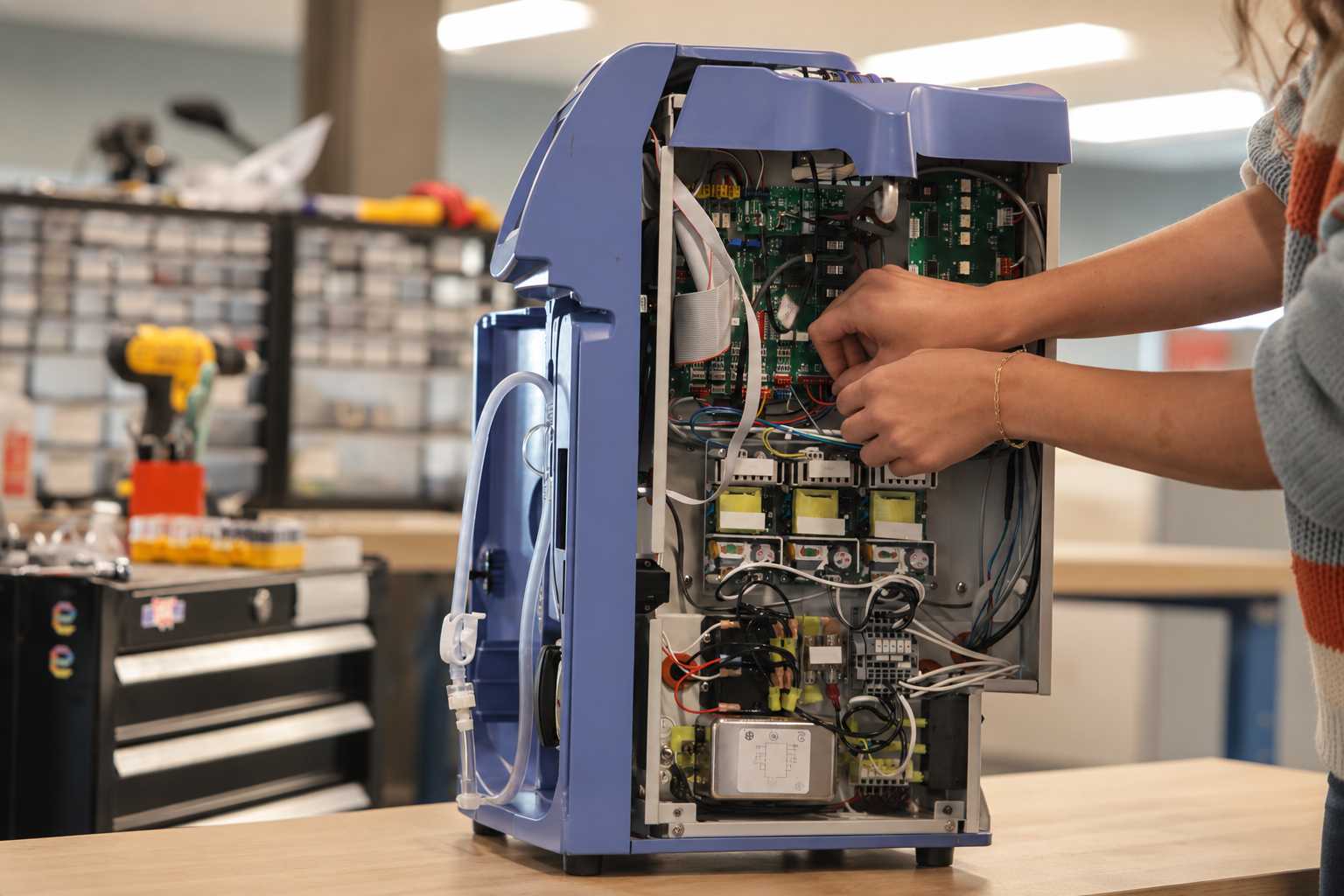
Pulsed field ablation (PFA) generators are medical devices. They are also extremely dangerous high-voltage power electronics, and a responsible design framework must account for the hazards that come with both. At Engenious Design, we share what our team has learned keeping designers safe during development of these systems.
For medical device designers working on pulsed field ablation systems, understanding the hazard profile of these devices—for the patient, for the developer, and for the clinical environment—is not optional background knowledge.
PFA generators are subject to IEC 60601-1, the general standard for medical electrical equipment, along with the collateral standard IEC 60601-2-2 for electromagnetic disturbances. For now, most PFA generators fall under the -2-2 standard for high-frequency surgical equipment, though the regulatory landscape is still evolving as PFA matures as a therapeutic category.
Operating at 1,000 to 5,000 V output has a practical implication: isolation creepage and clearance distances in the design become substantially larger than those required for conventional low-voltage medical devices, and isolation test voltages scale accordingly. These are not details to revisit at verification. They must be designed in from the beginning, as they affect circuit board design, and the design and selection of isolation barrier-crossing components. Each of these design outputs are safety-critical components.
The isolation architecture deserves particular attention. High-voltage pulses are delivered through a catheter or applicator to patient tissue. The return current path, the grounding scheme, and the isolation barrier between the high-voltage output stage and the rest of the system must be engineered with the same rigor applied to pulse generation itself. A failure in isolation is not just a functional issue; it’s a patient safety risk.
Radiofrequency ablation generators operate at high voltage in a continuous or near-continuous mode. PFA generators operate in brief, intense bursts. That difference in application produces a meaningfully different hazard profile.
The energy storage elements in a PFA generator, typically large capacitor banks, can hold lethal charge even when the device appears to be powered off. A capacitor charged to 5 kV and sized to deliver 250 kW pulses contains enough energy to cause instant fatality. This is a dominant hazard in the development environment, where operator training, experience, and physical protections are important.
Additionally, the rapid switching in a PFA output stage generates significant electromagnetic emissions. In a clinical environment, these emissions interfere with other equipment. In a development environment, they complicate instrumentation and easily corrupt measurement data in ways that are difficult to diagnose. Electromagnetic Compatibility cannot afford to be an afterthought in these designs in our experience.
Discharge interlock architecture. Any PFA generator design should include a reliable, verifiable discharge path for energy storage elements. Active discharge circuits, hardware interlocks that prevent access to high-voltage sections while charged, and clear visual indicators of charge state are all part of a responsible architecture. Designers should be trained to assume the system will be probed by a technician who isn’t aware of the hazards. And protect against the hazards with discharge paths.
Isolation verification. Build in-circuit isolation monitoring if the architecture supports it. At minimum, define a verification protocol that tests isolation integrity before and after any high-voltage operation.
Grounding scheme documentation. In a system with high instantaneous currents and fast switching edges, ground is not a passive reference, it is an active participant in the circuit. Document the grounding architecture explicitly, and understand where return currents flow during a pulse event. Misunderstood grounding is one of the most common sources of both electromagnetic interference problems and unexpected voltage differentials in these systems.
Regulatory engagement early. IEC 60601 standards provide a compliance floor, not a safety ceiling. If a device is novel in its output characteristics, and many PFA devices are, engage with the regulators and safety agencies before the design is locked. Regulatory standards were written for device categories that existed at the time they were written. PFA is comparatively new, and still being assimilated into the framework.
Safety in pulsed field ablation generator design is not a checklist activity. The hazard profile: high stored energy, high instantaneous power, pulsed electromagnetic interference, and novel tissue interaction, these require an engineering team understands the risks at a level that goes beyond compliance. For these reasons, it is best to work with an experienced team or engineer who has solved these safety problems in the past.
Developing a pulsed field ablation generator? Contact Engenious Design to learn how our experience with high-voltage architecture, isolation and electromagnetic compatibility can help your team build safety into the system from the start.
PFA—Pulsed Field Ablation. A therapeutic technique that uses high-voltage electrical pulses to destroy targeted tissue through irreversible electroporation as opposed to thermal energy.
PEF—Pulsed Electric Field. The broader technology category; PFA is a clinical application of PEF. The terms are sometimes used interchangeably in medical device contexts, though PEF is the more general descriptor.
ESU—Electrosurgical Unit. A device that uses high-frequency electrical current to ablate, cut or coagulate tissue through thermal energy. ESUs are the established FDA category PFA generators are often regulated under, despite the different underlying mechanism.
RFG—Radio Frequency Generator. A generator that produces high-frequency alternating current for electrosurgical or ablation applications. RF ablation uses thermal energy to destroy tissue; often cited as the incumbent technology that PFA is positioned to improve upon in selectivity and safety profile.