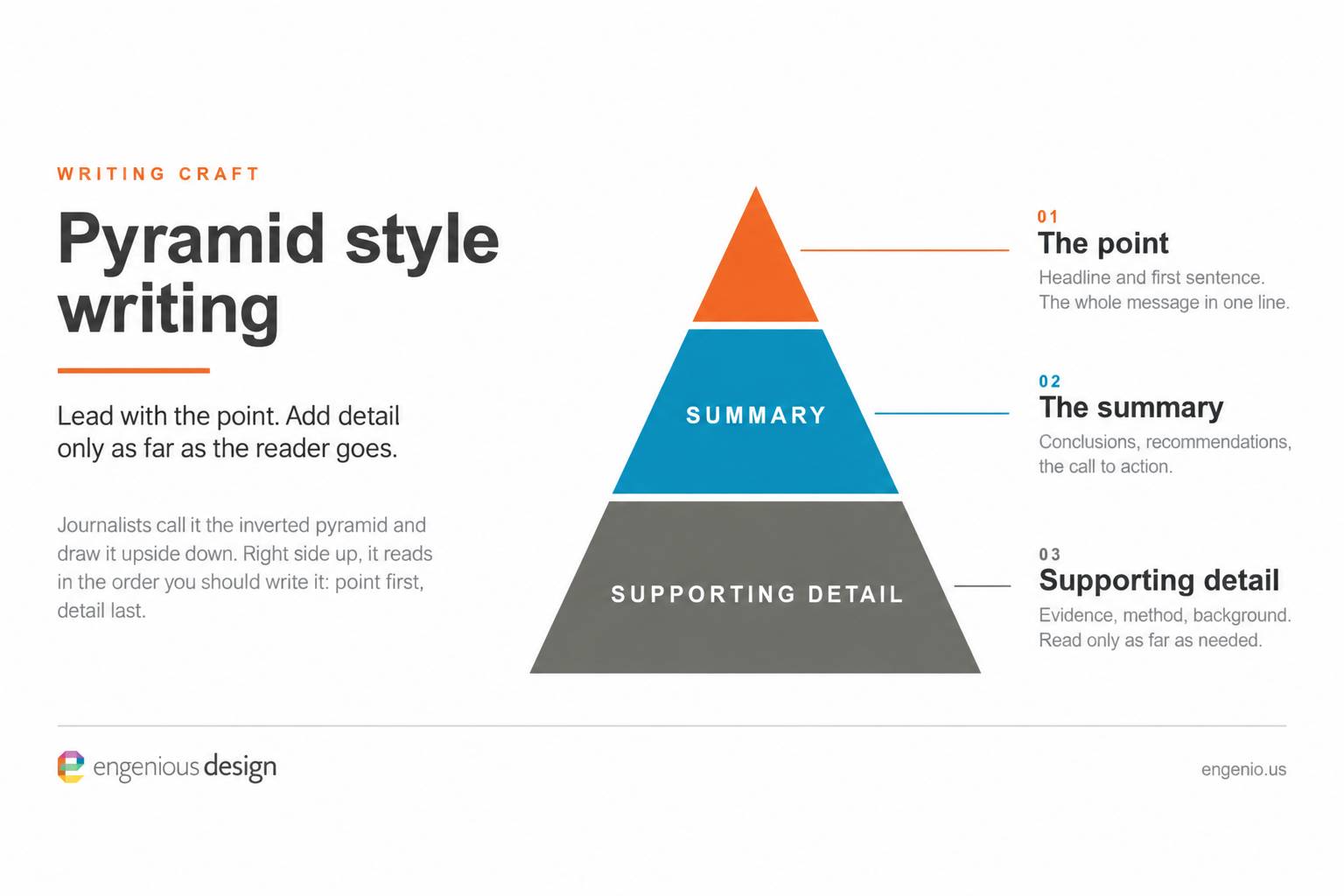
Anyone who wants to be heard or influence what happens needs to understand and apply the Inverted Pyramid writing style because it places important information up front, with increasingly-detailed support to follow. At Engenious Design , we practice this for the benefit of clients, and each other. This article is my case to you for learning and practicing Pyramid style writing.
In our modern age, we are drowning in information and data, which ironically puts increasingly less value on raw information. Today, people don’t need MORE information, but rather people need better-packaged information. We need to sharpen our writing craft to be more like old school journalists, and less like novel authors, or worse: academics. I’m sure you have a modern attention span, meaning a very short one. Our clients are the same; too much to read and increasingly scarce patience for reading it. In 2004 attention spans were 2.5 minutes on average, but by 2025 they have shrunk closer to 40 seconds. That downward trend sets a high bar for anyone still reading this article who wants attention on their writing!
If you have been around me for any length of time, you likely heard me mention the Inverted Pyramid style of writing. It’s a journalistic style borne of the newspaper age, and it’s a style that can serve us well in all of our writing; technical, managerial, and marketing. For newspapers, this style served a practical end because the person doing page layout for the newspaper late in the day (after everyone else went home) could just trim the last sentence/paragraph/whatever without even reading the article, and still deliver a cohesive article under a daily press deadline. No matter what got chopped off, the article still read as complete, which is pure process genius!
And to catch reader’s attention, the Inverted Pyramid style places the most essential information up front, even before the real article. This is why there is an art to writing a great headline, with disciplined practice required to become a truly-great headline writer. In Inverted Pyramid style, the first sentence gives a synapsis of the whole article, with every following sentence providing increasingly more detail and nuance. The more you read, the more supporting detail you get. But even if you stop reading after the first paragraph, you walk away knowing the most essential information. Even the clickbait masters have learned the importance of a great headline, and you should too because it means your message will get more attention than a long, boring headline or article that no one wants to read.
Terrible technical writing is often written like a novel; and we all suffer for this style of writing. Don’t get me wrong: novels have their place (at the beach, or when you are relaxing). Bad tech writing starts with lots of supporting information that builds to some conclusion, and eventually winds around to the story climax aka “conclusion”. Technical writing with the conclusion at the end is one of the worst style of technical writing! A poor reader must read the whole thing to truly understand and appreciate the climax. This style of writing is good for entertaining novels, because reading just the climax of Harry Potter would not be the same experience as reading the whole story, getting invested with the characters and appreciating the gravity of events. But what makes for great literature makes for terrible technical writing because it forces a heavy burden of work on the reader who is not sitting on the beach relaxing; they are trying to get important work done under some kind of pressure.
A few thoughts, for next time you write any email, slack message, status report, technical report, presentation or web content:
When I’m writing something important, I’ll outline it first. Then write the recommendation/conclusion first (the “so what” of my message) and after that, I’ll write the supporting content. Importantly, I’ll circle back to refine the up-front conclusion, because the first iteration is never the best.
Give this writing style a test drive or double down on your already-great writing.